Saturday, February 4, 2023

Bryce Canyon National Park, Kodachrome Basin State Park and Utah State Route 12

1/14/2023 - My body was sore and stiff from a day of hiking on sandstone in North Coyote Buttes, so I had a slow start to the morning. My knees and ankles were especially sore. I took my time waking up and eating breakfast in the hotel in Kanab, savoring everything about what had already happened over the week. I also appreciated the fact that I had no plans for the rest of the road trip. I could go anywhere I wanted. My ultimate goal for the trip had been accomplished.
 
I drove north from Kanab on State Route 89 and eventually connected with State Route 12. This route is a relatively young one, having only been paved with asphalt in 1985. It’s a National Scenic Byway which leads drivers through some wild country that was some of the last in the United States to be surveyed and mapped. My absolute favorite part about this route was the total lack of other traffic; I could drive for an hour and encounter one other car. My second favorite part was when the road meandered on the top of a hilltop and then dove down to the bottom of Escalante River Canyon, like an eagle pursuing prey. It’s a shame that I drove this part at twilight because I couldn't fully appreciate it in all of it's wild glory.

I made two stops along this route. The first was Bryce Canyon National Park. Upon my arrival, I was greeted with flurries of snow. But once I had parked at Sunset Point and installed the snow chains for my hiking boots, I was happily trudging along the icy path and consuming the view of Bryce Canyon from that spot. In those moments, the storm broke and sunlight poke through the clouds, illuminating the scene before me creating a truly magical moment.

“Special conditions,” I repeated to myself in excitement.


I hadn’t planned on it, but I hiked down into the canyon using Navajo Trail. The snow chains were a big help, otherwise I would have slipped and went sliding down the canyon to my doom. Bryce Canyon is filled with orange hoodoos carved by water and wind over millions of years. Many of them look eerily like people. In fact, Native American legend says these were once actual people who were turned to stone by the gaze of the trickster coyote.

I strolled the icy switchbacks down Wall Street, dwarfed by the sandstone walls on either side. Occasionally the sun would reappear and make the orange walls glow. Snow sat on the tips and ledges of the walls and hoodoos like vanilla frosting. Bryce Canyon was another one of those places I had only ever seen in photos before. Seeing it with my own eyes in these conditions was spectacular.

I hiked all the way down into the canyon and stopped at a fork in the trail. I gathered my breath here and chatted with some fellow hikers before beginning the slog back up the canyon. If walking an icy trail downhill is difficult, the slog back uphill is even more so. I took my time, though, and reminded myself that easy does it. With each step back up the switchbacks my body got more into rhythm. Eventually I reached the rim of the canyon once again, exhilarated from a once-in-a-lifetime hike.

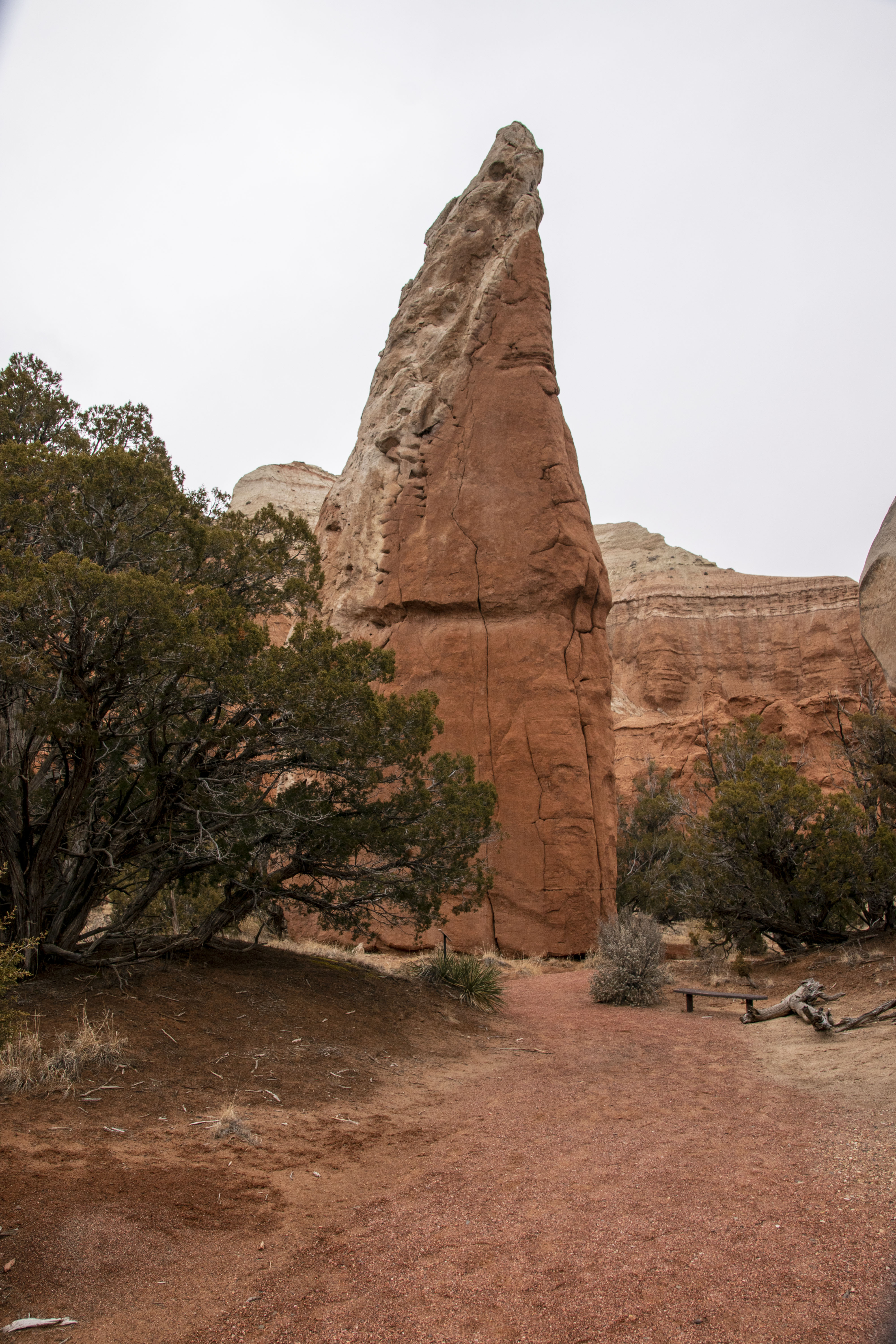
Afterwards, I drove to Kodachrome Basin State Park. I didn’t spend a lot of time there, but I did go on a nature walk and was greeted by a stone spire that looked suspiciously phallic. I had no idea this specific spire existed; I just knew Kodachrome Basin as a place with cool rock spires, almost 70 of them. It's an isolated state park as you have to drive about seven miles south of the tiny community of Cannonville and watch out for cattle crossing the road. It is yet another place for geology lovers.


But I didn't stay long. The sky was turning dark and gray, and rain began to fall. So I returned to Cannonville and turned back onto Utah State Route 12 where I drove for another few hours. I stopped at roadside information signs, such as the one that pointed out an ancient Native American storage structure high in the cliffs in an alcove, kind of like the homes Navajo National Monument preserves in Arizona. I drove through the community of Escalante and nearly hit some deer in town, the fourth one I had nearly hit that evening. Escalante looked like a nice little town with plenty of accommodation, but I kept going.

Since it was turning dark on this meandering road with bad cell reception and I had nearly hit four separate groups of deer in just a few miles, I decided to call it a day when I arrived in the tiny ranching town of Boulder. I stopped at the Circle Cliffs Motel where two men and a friendly cat took my reservation in the office, smelling strongly of marijuana.

I don't remember there being any restaurants or any place to buy food in Boulder, so I just enjoyed my own snacks that night and the hot chocolate from the motel, and the murder mysteries on the television.

Thursday, February 2, 2023

Hiking to The Wave

1/13/23 - This was it, the reason for this road trip. 

The day had come when I would hike to The Wave, an extraordinary geological feature in North Coyote Buttes of the Paria Canyon/Vermillion Cliffs Wilderness. I woke up before dawn and got ready in a state of excitement. My heart rate was faster than normal while I packed my things in the hotel room. I had trouble focusing on any one thing. I wolfed down a hearty breakfast in the hotel lobby and then walked towards my horse for the day: the 2022 Jeep Gladiator.

I had picked up the rented Jeep the night before from a local resident. He showed me how to shift the truck into four-wheel drive and gave me some advice regarding the road leading up to the trailhead, and how to find The Wave. The Bureau of Land Management includes a map with photos of landmarks to look out for along with the highlighter-pink permit when sent through the mail, but it is commonly dismissed by experienced hikers. He told me it isn't obvious as to where The Wave is. I told the guy I would be using GPS, which made him feel better. I hopped into the driver seat feeling as if I had just jumped into a tank. Not used to driving such a rugged vehicle, I gingerly drove it the three blocks to the hotel parking lot.

The Jeep was ready to go in the hotel parking lot in the morning, next to the Camry. I left Kanab when it was still dark, with a sliver of light and adventure on the horizon.

I reached Houserock Valley Road quicker than I anticipated. I began driving on this reddish dirt road during sunrise when pink streaked across the sky. The hills on the west side of the valley began to glow with early morning frigid January sunlight. 

There was a rainstorm a few days before my arrival. The rain actually damaged this road, undercutting the shoulders and eroding other parts of the road. Some parts were a muddy, sloppy mess. Others were submerged in large puddles of water. And other parts of the road were rough and bumpy. There were dips through washes. No matter what I came across, the Jeep handled it comfortably. I never had to shift into four-wheel drive, but I'm glad I had this machine. The Camry would have been beaten up by this road.


I found a reasonably large dirt parking lot at the trailhead complete with bathrooms, informational signs and a register. I packed my backpack with everything I would need, put on my orange Caltrans jacket over my highlighter-green shirt that I had received as a Christmas gift, and walked to the register where I signed my name, permit number, what time I started and what car I drove. While I did this, a sedan pulled into the parking lot, driven by a young kid in his early 20s. He and his girlfriend got out of the car, visibly shaken by the journey on that dirt road and wondering whether their car took damage. The guy shook his head saying, "never again." He and his girlfriend argued.

A permit is required to hike this trail. To get a permit, you must enter a lottery offered through the Bureau of Land Management. You can apply for up to three dates once a month and the lottery results are released on the first of the month. It costs $9 to enter the lottery. If you win the lottery, then you need to actually apply for the permit which costs $7. It then takes a month and a half for the BLM to mail the permit to you. Along with the permit, the BLM includes a map complete with landmarks to help you orient yourself, GPS coordinates, information on heat stroke and exhaustion, and an invitation to attend an orientation at a BLM office the day before the hike in Page or Kanab. 

The trail began with a 15-minute walk that followed the curve of a wide wash. Eventually I exited the wash via a trail on the south side that led over a hill, and the sandy path began to turn towards the south. There was no established, official trail on the way to The Wave. Hikers must be in decent shape, be able to scramble up and over rock, and be skilled in navigation. 


In the first mile or so of the hike, there were a couple of metal posts spread a few hundred feet apart indicating a hiker is headed in the correct direction. But they suddenly stop appearing. You're then left to your own devices in wilderness, surrounded by mind-blowing geology. It's easy to get lost. I sure did a couple of times. Before departing on the road trip, I downloaded a hiking app called Gaia. This app allows you to download trail maps for offline use. While on the trail, you can open a topographical map and see where you are in relation to the route. This map was immensely helpful to me a couple of times, especially in the moments when I was distracted by some weird formation I had never seen before. 

During one such time while I was finding my way back to the proper route, I found myself walking through an icy wash. My foot foot broke through ice and I felt cold water. Great. 

Farther along, I spotted a pair of bighorn sheep high up on one of the formations. I watched them while they eyed me. Unfortunately, the bighorns and I could hear the young arguing couple approaching from behind, chattering in loud voices, so the sheep disappeared from view before the young couple could see them. 

I also briefly chatted with a small group of hikers being guided by a young woman who lived in Kanab. She gave me some good advice about how to get myself oriented to an unfamiliar landscape, so I could find my way back to the trailhead. She also made an approving comment about my bright, eye-watering colors, noting with a smile that she could definitely see me from far away.

While the vast majority of the hike was over solid orange-red sandstone, there were stretches filled with sand littered with footprints. However, these footprints were everywhere. One lesson I certainly learned on this day and something I had heard before: do not follow footprints while in wilderness. This will get you lost, as I did a couple of times. Once was halfway along the trail when I got way off track, going too far west. The other was actually very close to The Wave, in a sandy wash that led me into a shady, icy bottleneck that was impossible to pass. I had to retrace my steps. Instead of following the wash, I had to climb more rock above the wash. 

Since this was January in the middle of winter in the high desert, climbing this sandstone could get tricky quickly because of the combination of snow, ice and sand sitting on the rock. Traction could disappear in a hurry. Thank goodness for trekking poles! The phrase "easy does it" was never more true than on this day, Friday the 13th. 


With some final steps and a turn, I reached a point where I saw lines and curves in the wall a little bit too perfect. I had arrived at The Wave. The formation looked exactly like what I had seen in photos and video, but I had never seen anything like it before. I'm used to rock being uneven, rough, messy, chaotic. This formation, however, was perfectly sculpted with gentle curves, artistic motion, and even layers. I tried to imagine how something like this could form. For some reason over agonizingly long periods of time, layers of sediment settled faultlessly on top of the last, eventually creating this exquisite natural masterpiece. 

I noticed a couple of spots that looked like a large splotch of paint, like a supernova. These places made me wonder if something at some point in time disturbed these harmonious layers, creating a disturbance in the pattern. I struggled to comprehend it. 


But I very much enjoyed trying. 

Inside The Wave, I chatted to a group of older hikers who told me they had been waiting 12 years to win a permit for this hike! Another group said they had waited a year. I sheepishly told them I had only waited three months. I told them perhaps I got so lucky because I applied for Friday the 13th. I wondered if fewer people entered the lottery due to superstition. 

After taking photos in the bright mid-day sunlight, I decided to take a rest and have some lunch. I chose a perch above The Wave in the shade. Here I observed a young family led by an in-charge mother who assertively marshalled each of the children and her husband, a thin man who looked relieved that he didn't have to be in control of the situation. There was another group of younger hikers. It seemed that most people took a higher perch to keep out of the way of the main formation. However, there was one guy who flew his drone above the formation, making a lot of noise that cut the silence and stillness of the area. 


There are other features around The Wave. The geology in this area is stunning. To see other things, you have to climb a steep hill. With The Wave at an elevation above 5,000 feet, the land above it became more icy and snowy. I was pleased with the little amount of snow coverage inside the formation, but I was a little wary of seeing snow on the steep slopes that led to other formations in the area, like an arch (which can actually be seen at the top of the hill in the photo at the beginning of this post, and the top right corner in the below image). 


That doesn't mean I didn't try to hike to the top of that hill. But after a certain point, I reminded myself that I was hiking alone and it wasn't worth taking big risks in that situation. Live to return another day. The formations won't go anywhere. 


While I was exploring this formation and the surrounding area, I noticed that there was a lack of energy like what I felt in Monument Valley. The Wave is an incredible natural phenomenon, but it didn't have the same impact on me like what I experienced in the Navajo Nation. It was slightly underwhelming. "Disappointing" popped into my head. I had been waiting for this day for years. My expectations and fantasies hadn't matched reality. Or, perhaps it was because I had reached the end of a long road; I had accomplished an important goal and was having the familiar empty feeling of "now what?"

Having said that, this place was photography heaven, a landscape photographer or geologist's wet dream. I cursed a few times after seeing what kind of images I had produced from the site. The sandstone really does look like a wave. The long, sweeping curves are pleasing to the eye. I saw how bright and vibrant the colors of each layer are. I saw red, orange, yellow, pink, green, white. I was even treated to some soft, gentle light when a high, thin layer of cirrus clouds move in during the afternoon and muted the harshness of the sunlight. 


In the early afternoon, people began to filter out to hike back to the trailhead. I found myself alone within the formation. I heard nothing but buzzing in my ears from dead silence. I took this opportunity to photograph more and to savor my last opportunity in the area. I found it slightly difficult to start the journey back to the trailhead because I had spent so much time and effort preparing for this day, and I knew it would be a long time before I would possibly return. 

But it had to be done. I was satisfied with the 500-plus images I captured with the Nikon D3500. As I stepped towards the exit of The Wave, I encountered a pair of hikers with their friendly black dogs. I told them they would have it all to themselves and that they had some great light to enjoy. Sometimes a late start isn't so bad after all. 

On the hike back to the trailhead, landmarks looked relatively familiar to me and I only took one route which wasn't correct. It was almost a relief to return to the trailhead where I could take off my hiking boots and relieve myself of the backpack. Before I could sign myself out from the register, a park ranger asked me if my name was Michael. I confirmed, and he said he had already signed me out, and then we had a chat about the hike, the conditions, and whether I was able to see any of the other features. 

Back in the Jeep, I gingerly began the drive back to Kanab, stopping briefly at the trailhead for Buckskin Gulch which is the longest slot canyon in the country. Hikers must acquire a permit for this trail as well. 

The hike properly wore me out. My knees and ankles were sore in particular. So, I took a few hours to rest in my hotel in Kanab. Hunger began to call, so I gingerly walked down the street to a vegetarian restaurant where I treated myself to pizza and beer. I sat near a professional, vibrant photo of The Wave in which the sky was electric blue and the rock was properly orange. 

Now I had my own images of The Wave.

Wednesday, February 1, 2023

The tour of Monument Valley

1/11/23 - Before my stay in Monument Valley, I wanted to book a tour of the valley with a guide. In the weeks before I departed Bishop, I had found a tour operator's website which offered an all-day tour of the valley as well as Mystery Valley. I was interested in that service but did not make a reservation for whatever reason. 

Fast forward to my arrival in Monument Valley. I had waited too long to book a tour from one of the many tour operators available and was unable to book a tour spot online the night before. When checking in to the hotel, they give you a sheet of paper with many different tour operators and their contact information. So during my first morning there, I started calling different numbers at random in an attempt to get a last-second spot on one of the tours because this was important to me. Most of the time I left a voicemail. One operator picked up, but they were out of town.

Finally, I got a hit. This operator had an open spot on a private tour. My guide would be Samuel and he would be driving a black 1995 Chevy Suburban. The tour would be 2.5 hours and we would meet at 10 am, an hour from the phone call. Normally, the general public is allowed to drive on the dirt road around the valley, but only on a certain loop. There are other dirt roads branching off the main route, each with a sign saying "private tour only" or "private property." The main dirt road is rough in places, wash boarded and rocky.

I walked to the meetup point just as Samuel pulled up. He had dark skin, short black hair and was slightly overweight. He wore a brown hoody and a black face mask. Like at Upper Antelope Canyon, facemasks are required to be worn in Monument Valley because it's part of the Navajo Nation and inside the Navajo Nation Tribal Park. Covid-19 has hit Navajo Nation particularly hard, so the natives have been cautious with opening back up to the outside world. 

Samuel had been born in Monument Valley and always lived there. He spoke of the pressures he felt taking care of his family and earning money for daily living. He told me about his brother’s recent death from sepsis, a result of heavy alcoholism. We discussed depression and anxiety, how the two often lie to us. When you think your friends and family don't want to hear about your problems and you don't want to be a burden to them, that's depression lying to you. 

I got the distinct impression that life in the Navajo Nation was rough and difficult.

Samuel took me to John Ford Point, a cliff overlooking a portion of the valley, telling me about different celebrities who’ve toured this area while I ordered Navajo fry bread from a shabby cafe. He also showed me the spot on the cliff where a native was struck dead by a lightning bolt. He showed me the famous buttes including the West Mitten, East Mitten and Merrick Butte. He told me about the other mesas in the valley, all while I stared in awe at these massive, desert varnish-adorned natural structures. I asked at one point if glaciers formed this valley; like most of the sandstone in the desert of Utah and Arizona, wind and water have chipped away at the rock for eons. I learned that a rock fall from a butte or mesa is seen as a bad omen. He told me that the buzz I hear in moments of complete silence is the spirits attempting to get my attention.


After we finished discussing deep issues such as alcoholism and mental health, Samuel asked me if I drink. I told him I do sometimes socially drink, but I don't keep alcohol in my apartment. My vice is marijuana. I smoke right before bed most nights; it's part of my bedtime routine which helps me sleep. That seemed to surprise him. He then asked if I'd like to smoke with him!

Right as he asked me this, we arrived at the first of several natural sandstone arches we'd see that day: Big Hogan. As soon as I got out of the suburban, I could sense that this arch emitted some sort of energy. I cannot explain exactly what I felt, but I sensed something there. I chose to walk around in silence, looking upwards towards the arch. There was no need to talk, but when he or I did speak I noted the echo around the walls. I could see a face in the formation with long hair. I had a thought that this would be a good place to meditate. 


The other arches Samuel showed me were Moccasin Arch, Sun's Eye and Ear of the Wind. I felt the same kind of energy that I sensed at Big Hogan and it gave me an overwhelming sense of gratitude. Emotion bubbled up. The silence of this area combined with the sense of gratitude and the unknown energy made me see that this day was shaping up to be something special.


He showed me a few walls on which petroglyphs existed. We had an interesting discussion about what the various images could possibly mean. That's when I found my own marijuana in my backpack wrapped in a plastic bag; I had forgotten that I stuck it in my backpack so it wouldn't stink up my hotel room. I offered some to Samuel and he gladly accepted. If I was already feeling overwhelmed with gratitude, the buzz from taking a drag or two with this Navajo man made me feel as if I were living a dream, driving around Monument Valley with a native. I was in an extraordinary situation, as if I had traveled to a different planet.


I spotted a fox at the base of one of the mesas. Samuel said he had never seen a tourist spot a fox here before. At one point later in the tour, I asked Samuel to remind me of his name again. Was it Sam? Much to my surprise, he told me his name was Shane. Sam handed me off to Shane a while back, don't you remember? It took me a moment to process this extraordinary piece of information but since I did not feel unsafe, I shrugged it off.

Another reason why this day was so special was that I was able to forge an immediate and strong connection to another human so quickly. This kind of connection is rare yet immensely profound in life. It's something I'll remember for as long as I live. Before Shane (Sam?) and I parted, he took me to his mother's house so I could pay for the tour with my debit card. I tipped the man $50 and when he dropped me off at the hotel, I thanked him for helping me create a positive memory that will last a lifetime. We embraced, and then parted ways. 

My only regret is that I did not give him my business card. 

They say people enter and exit your life for a reason. They pop up to provide some sort of value or lesson. Sam (Shane?) entered my life with the intensity of a raging wildfire, but then he exited just as intensely. Sam, I cannot thank you enough for what you did for me in only five measly hours.


I returned to the hotel exhausted. I went out that evening the photograph the sunset around the three famous buttes: the Mittens and Merrick. There were no clouds in the sky, but there were some faint anti-crepuscular rays. Though the wind made it bitterly cold, I felt excited at this chance to end a great day so spectacularly by photographing this iconic scene once again.


1/12/23 - I woke up naturally before dawn and was greeted with a golden stripe on the horizon, with the buttes as a silhouette. I felt as if an electric shock had coursed through me.

“Whoa!”

I was wide awake. I stepped onto my narrow balcony and snapped three photos. That’s all I needed.


After eating breakfast with a view of the sunrise over the mittens and packing my car covered with a hard frost, I bid this hotel a glum goodbye. This was after all a glorious experience, one that I’ll never forget. I took my time driving out of Monument Valley, drinking in that unusual landscape one last time.

Several hours later, I ate lunch in Page and then inquired about road conditions leading up to The Wave. One of the women on duty, a middle aged woman with glasses, scared me when she said I would need a permit for the hike and that I had missed my opportunity that day. I told her that I had already acquired my permit a few months ago and I was just asking for the road conditions of Houserock Valley Road. I told them I had been studying the maps for months and that I would rent a Jeep. That made the ladies feel much better.

I also called the owner of the Jeep Gladiator I would rent just to confirm that I would pick it up that evening. Before leaving Page, I took a tour of the Glen Canyon Dam visitor center and went to the Lake Powell shoreline. I was surprised to learn that Page was born because workers on the Glen Canyon Dam needed a place to stay in the early 1950s; it was a company town. I also learned that Glen Canyon was one of a few places along the Colorado River that was under consideration to be dammed. As I drove around Lake Powell for a few miles, I found myself thinking it was a shame that Glen Canyon had to be sacrificed so that the west could consume a little bit more water...

I tore myself away from this beautiful setting and hit the road once again, this time to Kanab, UT. I arrived in Kanab two hours before the agreed upon pickup time for the Jeep, so I hiked around the cliff overlooking the town to kill some time. 

The hotel I stayed at in Kanab was just a few blocks away from the pickup location, so I walked that way. The guy lending me the Jeep, Tanner, showed me some of the basics about the machine, including how to shift into 4WD. When I drove off in the machine, my excitement reached a peak. 

This was getting real.

Tuesday, January 31, 2023

A bend, a slot canyon and Monument Valley

1/10/23 - Today is a day that I’ll remember today forever; it was the kind of day where I was filled with wonder and laughter. It was the kind of day that left me emotionally exhausted.

I saw several amazing things: Horseshoe Bend, Upper Antelope Canyon and Monument Valley. The desert landscape around Page, AZ is incredible; I could see myself moving to this small town in the middle of God’s country because of the possibilities of outdoor recreation. Page itself is built upon a hilltop that provides great views in every direction. I was surprised to learn that Page was born as a result of the Glen Canyon Dam construction, the dam that harnessed the Colorado River which created Lake Powell.

I had seen photos of Horseshoe Bend for years. It’s the kind of place you see plastered all over social media by blond-haired Instagram influencers who sit on the cliff edge with their back to the camera, or with their arms thrown in the air, giving off a strong vibe of basicness. It is indeed a tourist magnet.


But for good reason. Horseshoe Bend was carved by the Colorado River over millions of years. The Navajo sandstone gives the cliff its reddish orange color and slanted layers. When I try to imagine how a natural feature like This forms, it blows my mind. I struggle to comprehend the magnitude of nature.

The parking lot is 10 minutes south of Page and costs $10 to park your car. A hiking trail leads visitors from the parking lot to the Bend, perhaps a half a mile long. Since this is a tourist trap, the cliff edge can get quite loud when busloads of tourists arrive, all chattering away in loud voices. The faint sound of highway traffic also reaches the cliff edge.

However, this bend is one of those things that is so big that it looks fake. Like the Grand Canyon, the Bend makes you feel small and insignificant. Thankfully, it's possible to hike along the cliff edge where you can get far away from other people in an effort to get a different point of view.

I arrived at the bend at dawn to photograph a colorful sunrise. Things we’re looking promising when I could see faint clouds in the predawn light, hovering around the shining moon. the clouds never lit up like I hoped, but I observed how the ambient light turned a shade of purple and how the morning sunlight crept along the landscape. I stayed for as long as I could, hiking around the rim getting different points of view. I had to give myself enough time to get back to town for the next adventure.

After returning to Page, I joined a tour of Upper Antelope Canyon. My group consisted of 11 people including myself all packed into a white van. Our tour guide, Rose, was a short Navajo woman in a black hoody and baseball cap. She gave us information about where the Navajo reservation began, how big it is, how long the Antelope Canyon wash is and the kind of rock found in the area. The group was well behaved and gave attention to Rose when she asked for it. Since the canyon is located in the Navajo Nation, face masks are required due to the Covid-19 pandemic. And because the canyon is so popular with tour groups, camera tripods are forbidden.


I had known Upper Antelope Canyon as a famous spot for photography. From the photos I have seen, it’s a great place to see light beams coming down from narrow openings in the ceiling, soft light on the smooth, contoured walls, and various shapes in the walls. I didn’t get to see light beams coming down from the ceiling because that doesn't happen in the winter, but I did see great light, shadows, shapes and faces in the canyon.


I was the only person in the group clutching a DSLR camera; everyone else carried a smartphone. They seemed to kindly give me extra space and point certain viewpoints out to me knowing I would appreciate it. As the tour progressed, I tended to drag behind, looking everywhere except straight ahead. It was a place I had never experienced before, enjoying every single moment of the short tour and snapping hundreds of photos. At some points I was forced forward by tour group behind mine, though they did wait patiently. Now that I’ve seen what kind of light is in this small, enclosed space, it’s a shame that tripods have been banned.


Having said all of that, I found it a difficult place to photograph because I normally struggle in low-light environments, and that I had to work quickly. That's not a bad thing, though; the challenge is welcoming. 

After returning to the tour van to drive back to Page, wherein the guide attempted to teach me how to say "thank you" in Navajo, I then drove towards Monument Valley with a brief detour to Navajo National Monument. This small park preserves the ancient cliff-dwelling homes of the Anasazi people. These crude homes are still standing under this cliff overhang after a thousand years; they chose this location because it stayed dry in the winter, and it had lots of sunshine during the cold parts of the year. One theory as to why the Anasazi people abandoned this area all those years ago is that there was a terrible drought that forced the people to find food and water elsewhere. I had the walk and viewpoint all to myself, perhaps because not many people choose to visit a small national monument in the dead of winter while snow covers the walking path. 

The landscape on the way to Monument Valley along State Route 98 and U.S. Highway 160 was consistently amazing, filled with canyons, jagged mountains, colorful rock bluffs and other rock formations, although very lonely and quiet. They're the kind of roads that don't see a lot of traffic. I first glimpsed Monument Valley from about 30 miles way in Kayenta. After turning north on US 163, I felt chills from head to toe the further in I drove. I was stunned by what nature showed me.


Monument Valley looks like a different planet with its larger-than-life bluffs and mesas. One one stretch of road about 30 minutes before sunset, a strong wind was blowing reddish dust around, creating a borderline dust storm. I stopped the car to take a picture but then I noticed dust blowing across the road, illuminated by the evening sun. This created what looked like golden dust. This, combined with the sight of huge bluffs glowing in the evening sun, made me roar with laughter. It was moments like this that we don't experience very often: magical and mystical times.


Once I was satisfied, I raced ahead in the hopes of viewing a vibrant sunset at my hotel which was located in the shadow of those iconic trio of bluffs; the West and East Mittens, and Merrick Butte. I saw a narrow band of color over the scene from the hotel parking lot, but it didn’t last long. I called it a day and checked into my hotel room on the top floor, which had an unobstructed view of the those same buttes.


Saturday, January 28, 2023

The road trip kicks off, camping in Valley of Fire, and bighorn sheep


1/8/23 - I woke up to snow in Bishop this morning.

My apartment, patio, and car were covered in a thin blanket of wet snow, much to my surprise. The latest storm of an active winter actually forced the snow level down to around 4,000 feet, so Bishop got its first measurable snow this season. Lately all of the snow had been confined to the higher elevations.

The snow gave me yet another reason to be excited, as today was the first day of my road trip. I had been restless yesterday getting ready for this adventure, packing the car and cleaning the apartment. I’ll be on the road for approximately two weeks, touring a number of national and state parks in Nevada, Utah and Arizona.

This is my first time taking two weeks off from work since 2020. On that occasion, I took two weeks off because my coworker caught Covid while at San Quentin State Prison in the beginning of the pandemic. Suffice to say, I did mot do anything of note besides stay in and around my apartment in San Rafael with mild anxiety as lockdowns had shut everything down in the Bay Area. Since then, I’ve taken a week here, a week there, a long weekend in between but nothing substantial. I had been burning out, especially over the summer when I spent a lot of time studying Google maps at work and fantasizing about a road trip through Utah and Arizona.

I write this from my campsite in Valley of Fire State Park, just east of Las Vegas, NV. I drove roughly 340 miles today, taking an indirect route through Death Valley National Park where I went to Dante’s View, an overlook on the east side of Death Valley that is known as a fantastic view during sunrise. I hadn’t visited here before, but I’m glad I took the 13-mile side trip up the mountain.


From there, I briefly stopped in Death Valley Junction, and then refueled in Pahrump, NV where gas cost $3.13 a gallon. I found myself admiring the mountains around this small, rural town and wondering whether I could live there.

From Pahrump I drove roughly 80 miles to Las Vegas where I got caught in heavy, aggressive traffic on Interstate 15. I did not stop in Vegas, even when I passed right by the glitz and glamor of The Strip. I wasn't at all interested in repeating the trip from 2019. On that occasion, I was forced to spend two nights in the city to wait out a snowstorm in Zion National Park and the Grand Canyon. No such storm is in the forecast this time around!

As a California resident, it cost $15 to enter Valley of Fire; it costs $10 to enter as a Nevada resident. This is Nevada’s first state park, being established in 1934. The road meanders through red and orange sandstone, creating a wild landscape that captures your imagination. This is a good place to go to practice landscape photography, particularly during early morning light or evening golden hour because the rock seems to glow in the same color as flame. However, you do need to dodge hoards of tourists looking for that Instagram-worthy picture. I wanted to see Valley of Fire for myself after hearing about the location from other photographers and seeing the images they created. I wanted to see the splash of color and the curvy lines for myself. And in some cases, the happy, jovial faces.


I was able to photograph The Beehives during golden hour and parked at the visitor center, where camp host Linda told me it doesn’t get windy here at night and the temperature gets down to about 40 degrees. She also told me to visit her in the morning to pay for my camp spot, as I don’t usually carry cash on me.


My camp spot was near Arch Rock, a natural arch surrounded by signs instructing tourists to stay off the rock. The campsite was very quiet and I had some privacy until an adventure van rolled into the spot next to me near midnight. I sat awake, annoyed, while my noisy neighbors hammered stakes into the ground. To their credit, they worked quickly and went silent shortly after they arrived.

While lying in my tent, I noticed the occasional drone of an airplane or jet flying into or out of Las Vegas. The stars are as bright as anything I’ve seen. Being January in the middle of winter, these spots are first come first served because not nearly as many tourists invade the park compared to warmer months. It was the same as other campgrounds I've visited; once you pick a site, you walk to the entrance to the ground and deposit your money in an envelope along with your site number, car details, number of people and how long you'll stay. Then you take the receipt stub and attach it to the metal stake standing at the entrance to your campsite.


1/9/23 – Last night while I was trying to sleep inside my tent, I heard what sounded like people laughing. The sound echoed around the sandstone mounds surrounding my campsite. Considering this sandstone has what looks like faces, this laughing sound was slightly creepy. I later learned that this sound most likely came from bighorn sheep in the park.

I got up early and drove to the Fire Wave trailhead. This hike is listed as 1.5 miles round trip, but it feels shorter. The trail follows metal poles which lead visitors to the wave. Being early on a Monday morning in winter, I had the Fire Wave to myself where I sat down above the formation and attempted to imagine how something like this takes shape.


I bumped into a herd of bighorn sheep upon returning to the trailhead. With the patterns In the rock and the landscape behind them, I was stunned with my photography luck. The sheep seemed comfortable around people because I could slowly approach them while they munched on the bushes. Similar to driving in snow or sand, the rule of thumb is no sudden movements when engaging in wildlife photography. There were roughly nine sheep; three of which hiked to the top of a stone hill and laid down, surveying the landscape. This was my first time seeing bighorn sheep in the wild; I did not expect this to happen, nor did I expect to be in such a great spot for it.


Marveling at such a terrific start to the trip, I departed Valley of Fire and drove to Saint George, UT, taking a familiar route on I-15 through the Virgin River Gorge. After having lunch in Saint George, the journey to Page was a long one which straddled the state line. I hopped on Utah State Route 59 through Apple Valley which morphed into Arizona State Route 389 through the Kaibab Indian Reservation, and then I re-entered Utah via Kanab and then Utah State Route 89. On this road I found the turnoff for the whole reason for this road trip: Houserock Valley Road.

Eventually I entered Page, AZ at twilight, where I first glimpsed the mighty Glen Canyon Dam and Lake Powell. I chose to get a cheap hotel room for less than $60 instead of camping. It was a good idea because it was freezing cold in Page.

Saturday, December 31, 2022

Preparing for a Big Road Trip

 12/14/22 - Life has never been better. 

I've lived in Bishop for more than two years now. It seems that I've landed in a place that suits me perfectly. I have no desire to be anywhere else anytime soon. I feel gratitude every single day for my situation. With world-class outdoor activities just outside of my front door, I live in a place people come from all over the world to visit for a vacation. The peaks of the Eastern Sierra and the White Mountains still tower over the Owens Valley. I try to walk outside early enough to see the sunrise each day and marvel at what's just outside of my house. I sometimes wonder if I'll ever get used to living here. 

My self-confidence has skyrocketed this year due to a combination of several things. Paying off the student loan was instrumental. It was a huge goal and I attacked it aggressively and consistently. I love my new apartment, its huge patio and grassy front yard. I did a fair amount of hiking over the summer and attempted some truly difficult hikes such as Gable Lakes, Bishop Pass, North Fork Big Pine Creek and Clouds Rest. I attempted hard shit all year, stuck with my plans and accomplished goals. I've impressed myself on multiple occasions. 

I finally understand why my parents love Yosemite National Park so much and why they consistently spend weekends there and hike there so much. They used to drag me to Yosemite in my childhood and teen years, but it was a chore to spend a whole day several hours away from home. I'm now 32 years old. I get a rush of excitement each time I pass through the eastern or western gate into the park. Yosemite is a wonderland. It's paradise, to such a degree that I pinch myself that I live close enough to visit several times a year. Some people will never visit Yosemite. Others will only get one chance to see the splendors of the Sierra. 

This year I hiked Clouds Rest, Glenn Aulin, Lembert Dome, Upper Cathedral Lake, Dog Lake, and ventured into Yosemite Valley for a short visit, all in the summer. I've seen a lot of the park, but it's still a tiny fraction of all Yosemite has to offer. 

I haven't done much traveling outside of eastern California, but I did fly to Alabama and Georgia for a long weekend to visit an old friend. I also spent a lot of time this year daydreaming about traveling to certain places within the United States, like Glacier National Park, Badlands National Park, Arches National Park, Vermillion Cliffs National Monument, or outside the states, like Uluru in Australia. One of my daydreams was to hike to The Wave, a red-orange sandstone geological feature on the north side of Vermillion Cliffs, near the Utah border. To do this hike, one much enter a lottery through the Bureau of Land Management for a chance to win a permit. For some people, this process takes years. For me, it only took about three months, perhaps because I accidentally applied for Friday, January 13 as one of the days I wanted to hike, among two others. 

I was supposed to learn of the results of my entry on October 1, the same day I hiked Clouds Rest with mom and dad. That epic endeavor, combined with our campsite on the west side of the park, put us out of cell range, so I did not have access to my email. On Sunday morning after waving goodbye to the parents, I decided to make a visit to Yosemite Valley. On the way down there, I noticed that my phone had weak cell reception, so I decided to check my email. In the brief moment when I did have cell reception, one word appeared that sent an electric shock through my body. 

"Congratulations!"

I screamed inside my car. I had actually won a permit to hike to The Wave! This meant I would be able to embark on one of my fantasy road trips through Utah and Arizona! 

Entering Yosemite Valley and being dwarfed by its towering granite cliffs usually makes me burst out in laughter. Along with the news that I would soon see an incredible geological feature, I felt as if I had drank an entire pot of coffee. I was high on life. 

Fast forward a couple of months. The road trip will happen about three weeks from now. I have this feeling in the back of my mind and my gut that this adventure will be one of the greatest things I will have done in my life. I have two weeks off from work, so that will give me plenty of time to enjoy the road. The first week is taking shape. My first major stop will be Valley of Fire State Park, just outside of Las Vegas, NV. From there, I'll head to Page, AZ where I'll join a tour of Upper Antelope Canyon, a world famous slot canyon. After the tour concludes, I'll drive to Monument Valley within the Navajo Nation, where I intend to watch a sunrise and sunset in that stunning landscape. After I get my fill there, I'll head to Kanab, UT and then eventually The Wave. 

After seeing The Wave, the road trip is wide open. All I have is a list of places to see: Canyonlands National Park, Bryce Canyon National Park, Arches National Park, Dead Horse Point State Park, Goblin Valley State Park, Hanksville, Utah State Route 12, and whatever else catches my eye. This will be a photography road trip. I expect to take thousands of photos and see awesome shit with my own eyes, things I've only ever seen in books or on the Internet. 

12/31/22 - I've begun watching weather reports for southern Utah and northern Arizona. The only thing in the forecast is partly cloudy days with highs in the 40s. In the week leading up to my hike to The Wave, there is only partly cloudy forecasts. This means there won't be much snow on the ground, if any, during my drive in and the hike. I can definitely imagine ice on the trail though. 

However, I think I'll still rent a Jeep in Kanab, UT to help me get to the Wire Pass trailhead. That dirt road off Utah State Route 89 is about 10 miles long and from what I hear, can be quite messy in wet weather. In dry conditions, I could possibly navigate it in my car; I don't want to take that chance. It is recommended to take a high-clearance vehicle on that road at the very least. The Jeep will guarantee that I reach my destination. 

I'm ready for the road trip. I'm prepared. I know the hiking route I want to take. I'll have warm clothes to help me stay out there all day. Plenty of food and water. Of course, I'll take the camera. 

Time to see some amazing things with my own eyes and feel joy and wonder.