Wednesday, February 1, 2023

The tour of Monument Valley

1/11/23 - Before my stay in Monument Valley, I wanted to book a tour of the valley with a guide. In the weeks before I departed Bishop, I had found a tour operator's website which offered an all-day tour of the valley as well as Mystery Valley. I was interested in that service but did not make a reservation for whatever reason. 

Fast forward to my arrival in Monument Valley. I had waited too long to book a tour from one of the many tour operators available and was unable to book a tour spot online the night before. When checking in to the hotel, they give you a sheet of paper with many different tour operators and their contact information. So during my first morning there, I started calling different numbers at random in an attempt to get a last-second spot on one of the tours because this was important to me. Most of the time I left a voicemail. One operator picked up, but they were out of town.

Finally, I got a hit. This operator had an open spot on a private tour. My guide would be Samuel and he would be driving a black 1995 Chevy Suburban. The tour would be 2.5 hours and we would meet at 10 am, an hour from the phone call. Normally, the general public is allowed to drive on the dirt road around the valley, but only on a certain loop. There are other dirt roads branching off the main route, each with a sign saying "private tour only" or "private property." The main dirt road is rough in places, wash boarded and rocky.

I walked to the meetup point just as Samuel pulled up. He had dark skin, short black hair and was slightly overweight. He wore a brown hoody and a black face mask. Like at Upper Antelope Canyon, facemasks are required to be worn in Monument Valley because it's part of the Navajo Nation and inside the Navajo Nation Tribal Park. Covid-19 has hit Navajo Nation particularly hard, so the natives have been cautious with opening back up to the outside world. 

Samuel had been born in Monument Valley and always lived there. He spoke of the pressures he felt taking care of his family and earning money for daily living. He told me about his brother’s recent death from sepsis, a result of heavy alcoholism. We discussed depression and anxiety, how the two often lie to us. When you think your friends and family don't want to hear about your problems and you don't want to be a burden to them, that's depression lying to you. 

I got the distinct impression that life in the Navajo Nation was rough and difficult.

Samuel took me to John Ford Point, a cliff overlooking a portion of the valley, telling me about different celebrities who’ve toured this area while I ordered Navajo fry bread from a shabby cafe. He also showed me the spot on the cliff where a native was struck dead by a lightning bolt. He showed me the famous buttes including the West Mitten, East Mitten and Merrick Butte. He told me about the other mesas in the valley, all while I stared in awe at these massive, desert varnish-adorned natural structures. I asked at one point if glaciers formed this valley; like most of the sandstone in the desert of Utah and Arizona, wind and water have chipped away at the rock for eons. I learned that a rock fall from a butte or mesa is seen as a bad omen. He told me that the buzz I hear in moments of complete silence is the spirits attempting to get my attention.


After we finished discussing deep issues such as alcoholism and mental health, Samuel asked me if I drink. I told him I do sometimes socially drink, but I don't keep alcohol in my apartment. My vice is marijuana. I smoke right before bed most nights; it's part of my bedtime routine which helps me sleep. That seemed to surprise him. He then asked if I'd like to smoke with him!

Right as he asked me this, we arrived at the first of several natural sandstone arches we'd see that day: Big Hogan. As soon as I got out of the suburban, I could sense that this arch emitted some sort of energy. I cannot explain exactly what I felt, but I sensed something there. I chose to walk around in silence, looking upwards towards the arch. There was no need to talk, but when he or I did speak I noted the echo around the walls. I could see a face in the formation with long hair. I had a thought that this would be a good place to meditate. 


The other arches Samuel showed me were Moccasin Arch, Sun's Eye and Ear of the Wind. I felt the same kind of energy that I sensed at Big Hogan and it gave me an overwhelming sense of gratitude. Emotion bubbled up. The silence of this area combined with the sense of gratitude and the unknown energy made me see that this day was shaping up to be something special.


He showed me a few walls on which petroglyphs existed. We had an interesting discussion about what the various images could possibly mean. That's when I found my own marijuana in my backpack wrapped in a plastic bag; I had forgotten that I stuck it in my backpack so it wouldn't stink up my hotel room. I offered some to Samuel and he gladly accepted. If I was already feeling overwhelmed with gratitude, the buzz from taking a drag or two with this Navajo man made me feel as if I were living a dream, driving around Monument Valley with a native. I was in an extraordinary situation, as if I had traveled to a different planet.


I spotted a fox at the base of one of the mesas. Samuel said he had never seen a tourist spot a fox here before. At one point later in the tour, I asked Samuel to remind me of his name again. Was it Sam? Much to my surprise, he told me his name was Shane. Sam handed me off to Shane a while back, don't you remember? It took me a moment to process this extraordinary piece of information but since I did not feel unsafe, I shrugged it off.

Another reason why this day was so special was that I was able to forge an immediate and strong connection to another human so quickly. This kind of connection is rare yet immensely profound in life. It's something I'll remember for as long as I live. Before Shane (Sam?) and I parted, he took me to his mother's house so I could pay for the tour with my debit card. I tipped the man $50 and when he dropped me off at the hotel, I thanked him for helping me create a positive memory that will last a lifetime. We embraced, and then parted ways. 

My only regret is that I did not give him my business card. 

They say people enter and exit your life for a reason. They pop up to provide some sort of value or lesson. Sam (Shane?) entered my life with the intensity of a raging wildfire, but then he exited just as intensely. Sam, I cannot thank you enough for what you did for me in only five measly hours.


I returned to the hotel exhausted. I went out that evening the photograph the sunset around the three famous buttes: the Mittens and Merrick. There were no clouds in the sky, but there were some faint anti-crepuscular rays. Though the wind made it bitterly cold, I felt excited at this chance to end a great day so spectacularly by photographing this iconic scene once again.


1/12/23 - I woke up naturally before dawn and was greeted with a golden stripe on the horizon, with the buttes as a silhouette. I felt as if an electric shock had coursed through me.

“Whoa!”

I was wide awake. I stepped onto my narrow balcony and snapped three photos. That’s all I needed.


After eating breakfast with a view of the sunrise over the mittens and packing my car covered with a hard frost, I bid this hotel a glum goodbye. This was after all a glorious experience, one that I’ll never forget. I took my time driving out of Monument Valley, drinking in that unusual landscape one last time.

Several hours later, I ate lunch in Page and then inquired about road conditions leading up to The Wave. One of the women on duty, a middle aged woman with glasses, scared me when she said I would need a permit for the hike and that I had missed my opportunity that day. I told her that I had already acquired my permit a few months ago and I was just asking for the road conditions of Houserock Valley Road. I told them I had been studying the maps for months and that I would rent a Jeep. That made the ladies feel much better.

I also called the owner of the Jeep Gladiator I would rent just to confirm that I would pick it up that evening. Before leaving Page, I took a tour of the Glen Canyon Dam visitor center and went to the Lake Powell shoreline. I was surprised to learn that Page was born because workers on the Glen Canyon Dam needed a place to stay in the early 1950s; it was a company town. I also learned that Glen Canyon was one of a few places along the Colorado River that was under consideration to be dammed. As I drove around Lake Powell for a few miles, I found myself thinking it was a shame that Glen Canyon had to be sacrificed so that the west could consume a little bit more water...

I tore myself away from this beautiful setting and hit the road once again, this time to Kanab, UT. I arrived in Kanab two hours before the agreed upon pickup time for the Jeep, so I hiked around the cliff overlooking the town to kill some time. 

The hotel I stayed at in Kanab was just a few blocks away from the pickup location, so I walked that way. The guy lending me the Jeep, Tanner, showed me some of the basics about the machine, including how to shift into 4WD. When I drove off in the machine, my excitement reached a peak. 

This was getting real.

Tuesday, January 31, 2023

A bend, a slot canyon and Monument Valley

1/10/23 - Today is a day that I’ll remember today forever; it was the kind of day where I was filled with wonder and laughter. It was the kind of day that left me emotionally exhausted.

I saw several amazing things: Horseshoe Bend, Upper Antelope Canyon and Monument Valley. The desert landscape around Page, AZ is incredible; I could see myself moving to this small town in the middle of God’s country because of the possibilities of outdoor recreation. Page itself is built upon a hilltop that provides great views in every direction. I was surprised to learn that Page was born as a result of the Glen Canyon Dam construction, the dam that harnessed the Colorado River which created Lake Powell.

I had seen photos of Horseshoe Bend for years. It’s the kind of place you see plastered all over social media by blond-haired Instagram influencers who sit on the cliff edge with their back to the camera, or with their arms thrown in the air, giving off a strong vibe of basicness. It is indeed a tourist magnet.


But for good reason. Horseshoe Bend was carved by the Colorado River over millions of years. The Navajo sandstone gives the cliff its reddish orange color and slanted layers. When I try to imagine how a natural feature like This forms, it blows my mind. I struggle to comprehend the magnitude of nature.

The parking lot is 10 minutes south of Page and costs $10 to park your car. A hiking trail leads visitors from the parking lot to the Bend, perhaps a half a mile long. Since this is a tourist trap, the cliff edge can get quite loud when busloads of tourists arrive, all chattering away in loud voices. The faint sound of highway traffic also reaches the cliff edge.

However, this bend is one of those things that is so big that it looks fake. Like the Grand Canyon, the Bend makes you feel small and insignificant. Thankfully, it's possible to hike along the cliff edge where you can get far away from other people in an effort to get a different point of view.

I arrived at the bend at dawn to photograph a colorful sunrise. Things we’re looking promising when I could see faint clouds in the predawn light, hovering around the shining moon. the clouds never lit up like I hoped, but I observed how the ambient light turned a shade of purple and how the morning sunlight crept along the landscape. I stayed for as long as I could, hiking around the rim getting different points of view. I had to give myself enough time to get back to town for the next adventure.

After returning to Page, I joined a tour of Upper Antelope Canyon. My group consisted of 11 people including myself all packed into a white van. Our tour guide, Rose, was a short Navajo woman in a black hoody and baseball cap. She gave us information about where the Navajo reservation began, how big it is, how long the Antelope Canyon wash is and the kind of rock found in the area. The group was well behaved and gave attention to Rose when she asked for it. Since the canyon is located in the Navajo Nation, face masks are required due to the Covid-19 pandemic. And because the canyon is so popular with tour groups, camera tripods are forbidden.


I had known Upper Antelope Canyon as a famous spot for photography. From the photos I have seen, it’s a great place to see light beams coming down from narrow openings in the ceiling, soft light on the smooth, contoured walls, and various shapes in the walls. I didn’t get to see light beams coming down from the ceiling because that doesn't happen in the winter, but I did see great light, shadows, shapes and faces in the canyon.


I was the only person in the group clutching a DSLR camera; everyone else carried a smartphone. They seemed to kindly give me extra space and point certain viewpoints out to me knowing I would appreciate it. As the tour progressed, I tended to drag behind, looking everywhere except straight ahead. It was a place I had never experienced before, enjoying every single moment of the short tour and snapping hundreds of photos. At some points I was forced forward by tour group behind mine, though they did wait patiently. Now that I’ve seen what kind of light is in this small, enclosed space, it’s a shame that tripods have been banned.


Having said all of that, I found it a difficult place to photograph because I normally struggle in low-light environments, and that I had to work quickly. That's not a bad thing, though; the challenge is welcoming. 

After returning to the tour van to drive back to Page, wherein the guide attempted to teach me how to say "thank you" in Navajo, I then drove towards Monument Valley with a brief detour to Navajo National Monument. This small park preserves the ancient cliff-dwelling homes of the Anasazi people. These crude homes are still standing under this cliff overhang after a thousand years; they chose this location because it stayed dry in the winter, and it had lots of sunshine during the cold parts of the year. One theory as to why the Anasazi people abandoned this area all those years ago is that there was a terrible drought that forced the people to find food and water elsewhere. I had the walk and viewpoint all to myself, perhaps because not many people choose to visit a small national monument in the dead of winter while snow covers the walking path. 

The landscape on the way to Monument Valley along State Route 98 and U.S. Highway 160 was consistently amazing, filled with canyons, jagged mountains, colorful rock bluffs and other rock formations, although very lonely and quiet. They're the kind of roads that don't see a lot of traffic. I first glimpsed Monument Valley from about 30 miles way in Kayenta. After turning north on US 163, I felt chills from head to toe the further in I drove. I was stunned by what nature showed me.


Monument Valley looks like a different planet with its larger-than-life bluffs and mesas. One one stretch of road about 30 minutes before sunset, a strong wind was blowing reddish dust around, creating a borderline dust storm. I stopped the car to take a picture but then I noticed dust blowing across the road, illuminated by the evening sun. This created what looked like golden dust. This, combined with the sight of huge bluffs glowing in the evening sun, made me roar with laughter. It was moments like this that we don't experience very often: magical and mystical times.


Once I was satisfied, I raced ahead in the hopes of viewing a vibrant sunset at my hotel which was located in the shadow of those iconic trio of bluffs; the West and East Mittens, and Merrick Butte. I saw a narrow band of color over the scene from the hotel parking lot, but it didn’t last long. I called it a day and checked into my hotel room on the top floor, which had an unobstructed view of the those same buttes.


Saturday, January 28, 2023

The road trip kicks off, camping in Valley of Fire, and bighorn sheep


1/8/23 - I woke up to snow in Bishop this morning.

My apartment, patio, and car were covered in a thin blanket of wet snow, much to my surprise. The latest storm of an active winter actually forced the snow level down to around 4,000 feet, so Bishop got its first measurable snow this season. Lately all of the snow had been confined to the higher elevations.

The snow gave me yet another reason to be excited, as today was the first day of my road trip. I had been restless yesterday getting ready for this adventure, packing the car and cleaning the apartment. I’ll be on the road for approximately two weeks, touring a number of national and state parks in Nevada, Utah and Arizona.

This is my first time taking two weeks off from work since 2020. On that occasion, I took two weeks off because my coworker caught Covid while at San Quentin State Prison in the beginning of the pandemic. Suffice to say, I did mot do anything of note besides stay in and around my apartment in San Rafael with mild anxiety as lockdowns had shut everything down in the Bay Area. Since then, I’ve taken a week here, a week there, a long weekend in between but nothing substantial. I had been burning out, especially over the summer when I spent a lot of time studying Google maps at work and fantasizing about a road trip through Utah and Arizona.

I write this from my campsite in Valley of Fire State Park, just east of Las Vegas, NV. I drove roughly 340 miles today, taking an indirect route through Death Valley National Park where I went to Dante’s View, an overlook on the east side of Death Valley that is known as a fantastic view during sunrise. I hadn’t visited here before, but I’m glad I took the 13-mile side trip up the mountain.


From there, I briefly stopped in Death Valley Junction, and then refueled in Pahrump, NV where gas cost $3.13 a gallon. I found myself admiring the mountains around this small, rural town and wondering whether I could live there.

From Pahrump I drove roughly 80 miles to Las Vegas where I got caught in heavy, aggressive traffic on Interstate 15. I did not stop in Vegas, even when I passed right by the glitz and glamor of The Strip. I wasn't at all interested in repeating the trip from 2019. On that occasion, I was forced to spend two nights in the city to wait out a snowstorm in Zion National Park and the Grand Canyon. No such storm is in the forecast this time around!

As a California resident, it cost $15 to enter Valley of Fire; it costs $10 to enter as a Nevada resident. This is Nevada’s first state park, being established in 1934. The road meanders through red and orange sandstone, creating a wild landscape that captures your imagination. This is a good place to go to practice landscape photography, particularly during early morning light or evening golden hour because the rock seems to glow in the same color as flame. However, you do need to dodge hoards of tourists looking for that Instagram-worthy picture. I wanted to see Valley of Fire for myself after hearing about the location from other photographers and seeing the images they created. I wanted to see the splash of color and the curvy lines for myself. And in some cases, the happy, jovial faces.


I was able to photograph The Beehives during golden hour and parked at the visitor center, where camp host Linda told me it doesn’t get windy here at night and the temperature gets down to about 40 degrees. She also told me to visit her in the morning to pay for my camp spot, as I don’t usually carry cash on me.


My camp spot was near Arch Rock, a natural arch surrounded by signs instructing tourists to stay off the rock. The campsite was very quiet and I had some privacy until an adventure van rolled into the spot next to me near midnight. I sat awake, annoyed, while my noisy neighbors hammered stakes into the ground. To their credit, they worked quickly and went silent shortly after they arrived.

While lying in my tent, I noticed the occasional drone of an airplane or jet flying into or out of Las Vegas. The stars are as bright as anything I’ve seen. Being January in the middle of winter, these spots are first come first served because not nearly as many tourists invade the park compared to warmer months. It was the same as other campgrounds I've visited; once you pick a site, you walk to the entrance to the ground and deposit your money in an envelope along with your site number, car details, number of people and how long you'll stay. Then you take the receipt stub and attach it to the metal stake standing at the entrance to your campsite.


1/9/23 – Last night while I was trying to sleep inside my tent, I heard what sounded like people laughing. The sound echoed around the sandstone mounds surrounding my campsite. Considering this sandstone has what looks like faces, this laughing sound was slightly creepy. I later learned that this sound most likely came from bighorn sheep in the park.

I got up early and drove to the Fire Wave trailhead. This hike is listed as 1.5 miles round trip, but it feels shorter. The trail follows metal poles which lead visitors to the wave. Being early on a Monday morning in winter, I had the Fire Wave to myself where I sat down above the formation and attempted to imagine how something like this takes shape.


I bumped into a herd of bighorn sheep upon returning to the trailhead. With the patterns In the rock and the landscape behind them, I was stunned with my photography luck. The sheep seemed comfortable around people because I could slowly approach them while they munched on the bushes. Similar to driving in snow or sand, the rule of thumb is no sudden movements when engaging in wildlife photography. There were roughly nine sheep; three of which hiked to the top of a stone hill and laid down, surveying the landscape. This was my first time seeing bighorn sheep in the wild; I did not expect this to happen, nor did I expect to be in such a great spot for it.


Marveling at such a terrific start to the trip, I departed Valley of Fire and drove to Saint George, UT, taking a familiar route on I-15 through the Virgin River Gorge. After having lunch in Saint George, the journey to Page was a long one which straddled the state line. I hopped on Utah State Route 59 through Apple Valley which morphed into Arizona State Route 389 through the Kaibab Indian Reservation, and then I re-entered Utah via Kanab and then Utah State Route 89. On this road I found the turnoff for the whole reason for this road trip: Houserock Valley Road.

Eventually I entered Page, AZ at twilight, where I first glimpsed the mighty Glen Canyon Dam and Lake Powell. I chose to get a cheap hotel room for less than $60 instead of camping. It was a good idea because it was freezing cold in Page.

Saturday, December 31, 2022

Preparing for a Big Road Trip

 12/14/22 - Life has never been better. 

I've lived in Bishop for more than two years now. It seems that I've landed in a place that suits me perfectly. I have no desire to be anywhere else anytime soon. I feel gratitude every single day for my situation. With world-class outdoor activities just outside of my front door, I live in a place people come from all over the world to visit for a vacation. The peaks of the Eastern Sierra and the White Mountains still tower over the Owens Valley. I try to walk outside early enough to see the sunrise each day and marvel at what's just outside of my house. I sometimes wonder if I'll ever get used to living here. 

My self-confidence has skyrocketed this year due to a combination of several things. Paying off the student loan was instrumental. It was a huge goal and I attacked it aggressively and consistently. I love my new apartment, its huge patio and grassy front yard. I did a fair amount of hiking over the summer and attempted some truly difficult hikes such as Gable Lakes, Bishop Pass, North Fork Big Pine Creek and Clouds Rest. I attempted hard shit all year, stuck with my plans and accomplished goals. I've impressed myself on multiple occasions. 

I finally understand why my parents love Yosemite National Park so much and why they consistently spend weekends there and hike there so much. They used to drag me to Yosemite in my childhood and teen years, but it was a chore to spend a whole day several hours away from home. I'm now 32 years old. I get a rush of excitement each time I pass through the eastern or western gate into the park. Yosemite is a wonderland. It's paradise, to such a degree that I pinch myself that I live close enough to visit several times a year. Some people will never visit Yosemite. Others will only get one chance to see the splendors of the Sierra. 

This year I hiked Clouds Rest, Glenn Aulin, Lembert Dome, Upper Cathedral Lake, Dog Lake, and ventured into Yosemite Valley for a short visit, all in the summer. I've seen a lot of the park, but it's still a tiny fraction of all Yosemite has to offer. 

I haven't done much traveling outside of eastern California, but I did fly to Alabama and Georgia for a long weekend to visit an old friend. I also spent a lot of time this year daydreaming about traveling to certain places within the United States, like Glacier National Park, Badlands National Park, Arches National Park, Vermillion Cliffs National Monument, or outside the states, like Uluru in Australia. One of my daydreams was to hike to The Wave, a red-orange sandstone geological feature on the north side of Vermillion Cliffs, near the Utah border. To do this hike, one much enter a lottery through the Bureau of Land Management for a chance to win a permit. For some people, this process takes years. For me, it only took about three months, perhaps because I accidentally applied for Friday, January 13 as one of the days I wanted to hike, among two others. 

I was supposed to learn of the results of my entry on October 1, the same day I hiked Clouds Rest with mom and dad. That epic endeavor, combined with our campsite on the west side of the park, put us out of cell range, so I did not have access to my email. On Sunday morning after waving goodbye to the parents, I decided to make a visit to Yosemite Valley. On the way down there, I noticed that my phone had weak cell reception, so I decided to check my email. In the brief moment when I did have cell reception, one word appeared that sent an electric shock through my body. 

"Congratulations!"

I screamed inside my car. I had actually won a permit to hike to The Wave! This meant I would be able to embark on one of my fantasy road trips through Utah and Arizona! 

Entering Yosemite Valley and being dwarfed by its towering granite cliffs usually makes me burst out in laughter. Along with the news that I would soon see an incredible geological feature, I felt as if I had drank an entire pot of coffee. I was high on life. 

Fast forward a couple of months. The road trip will happen about three weeks from now. I have this feeling in the back of my mind and my gut that this adventure will be one of the greatest things I will have done in my life. I have two weeks off from work, so that will give me plenty of time to enjoy the road. The first week is taking shape. My first major stop will be Valley of Fire State Park, just outside of Las Vegas, NV. From there, I'll head to Page, AZ where I'll join a tour of Upper Antelope Canyon, a world famous slot canyon. After the tour concludes, I'll drive to Monument Valley within the Navajo Nation, where I intend to watch a sunrise and sunset in that stunning landscape. After I get my fill there, I'll head to Kanab, UT and then eventually The Wave. 

After seeing The Wave, the road trip is wide open. All I have is a list of places to see: Canyonlands National Park, Bryce Canyon National Park, Arches National Park, Dead Horse Point State Park, Goblin Valley State Park, Hanksville, Utah State Route 12, and whatever else catches my eye. This will be a photography road trip. I expect to take thousands of photos and see awesome shit with my own eyes, things I've only ever seen in books or on the Internet. 

12/31/22 - I've begun watching weather reports for southern Utah and northern Arizona. The only thing in the forecast is partly cloudy days with highs in the 40s. In the week leading up to my hike to The Wave, there is only partly cloudy forecasts. This means there won't be much snow on the ground, if any, during my drive in and the hike. I can definitely imagine ice on the trail though. 

However, I think I'll still rent a Jeep in Kanab, UT to help me get to the Wire Pass trailhead. That dirt road off Utah State Route 89 is about 10 miles long and from what I hear, can be quite messy in wet weather. In dry conditions, I could possibly navigate it in my car; I don't want to take that chance. It is recommended to take a high-clearance vehicle on that road at the very least. The Jeep will guarantee that I reach my destination. 

I'm ready for the road trip. I'm prepared. I know the hiking route I want to take. I'll have warm clothes to help me stay out there all day. Plenty of food and water. Of course, I'll take the camera. 

Time to see some amazing things with my own eyes and feel joy and wonder.

Sunday, May 8, 2022

The Return to Portland and Chasing Waterfalls

 5/1 - After the excitement of a weekend in Southern California roaring around the desert with a motorcycle club, it's nice to have a weekend in which you do nothing. 

I have barely left the apartment this weekend. I love it. 

It's a break right before a busy four-day workweek. It's also a break before my next adventure. 

For my next trip, I'll visit Portland, Oregon! My last trek to Portland was in 2019 when I spent a weekend in the city and stayed in a hostel in midtown. I enjoyed wandering around downtown on foot with my camera and getting a taste of a new place.

This time, a friend will host me and pick me up from the airport. 

5/6 - Greetings from Portland. I drove 200 miles to Reno from Bishop and then flew to Portland from Reno. The Reno airport was strange because it was quiet; not many people were traveling early on Friday. I emerged from security oddly quickly. The TSA did not ask me to remove anything from my backpack, such as the laptop. That was weird to experience so little hassle while at an airport.

The journey to Portland was quick and painless. But here I am.

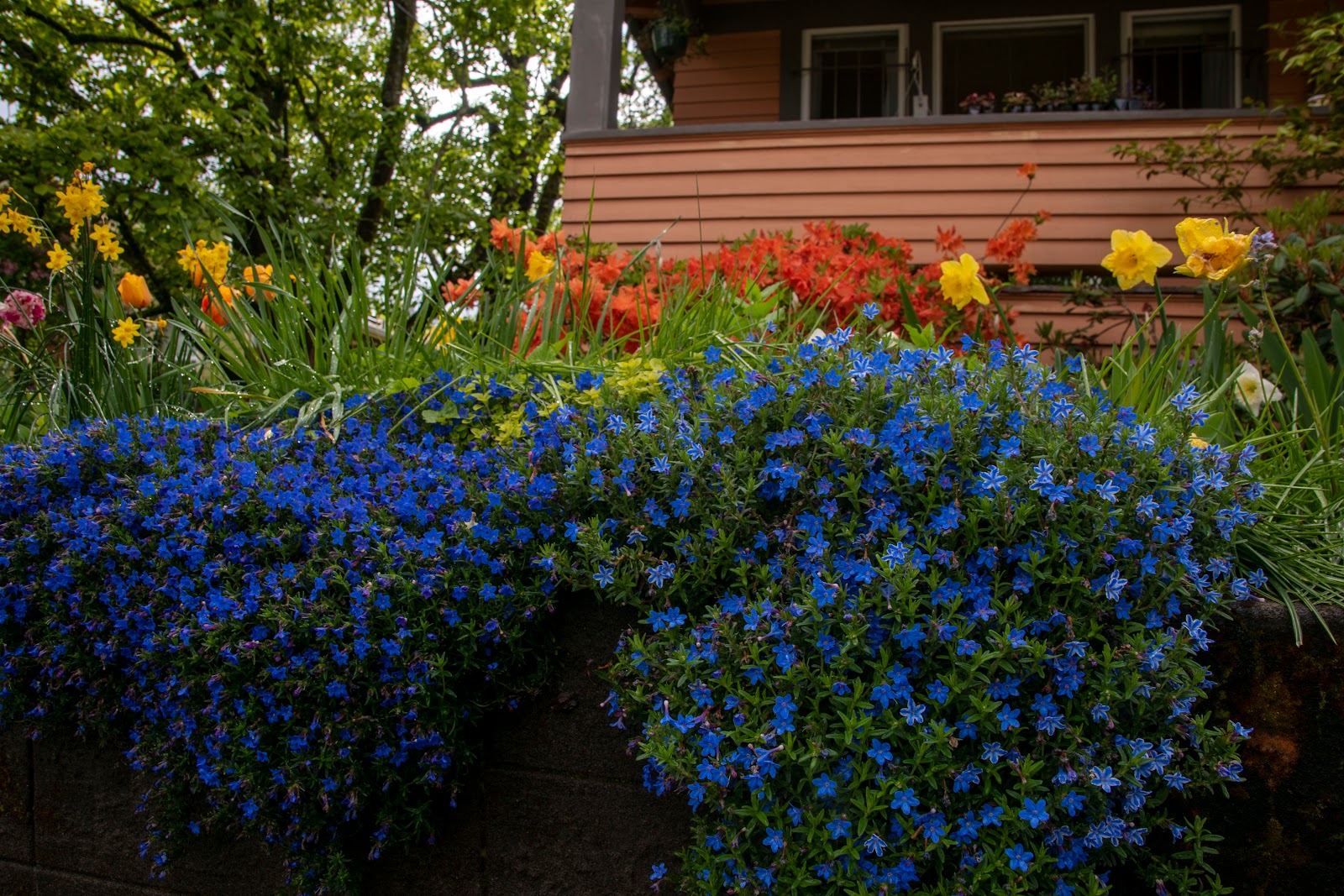
I was unprepared by how utterly, vibrantly, shockingly green it is in Portland. I’ve arrived in the middle of a springtime explosion of flowers. It’s wet and soggy from heavy downpours. I’ve seen a rainbow already. It has been a bit of a shock to the system, coming from a dry climate in the high desert where I’m used to seeing more subtle colors in the landscape; coming to Portland has felt a bit like having the lights turned on after my eyes adjusted to darkness.

Portland has been in the news over the past few years for violent protests in the streets. The National Guard came to the city in an effort to diffuse these protests I’ve come to a city with large homeless camps, expensive costs of living and heavy traffic. I learned yesterday that the city has a shortage of 1,000 police officers. You really have to watch yourself on the roadways because certain drivers know they can get away with driving recklessly. The city has its issues.

But my goodness is it colorful!


5/7 - During that road trip in Europe all those years ago, near the town of Lauterbrunnen, Switzerland in the Alps, I was mesmerized by the number of waterfalls crashing over the cliffs in that valley. I had never seen so many waterfalls in one area before; it was like wandering into a dream. That was a wonderful 12 hours spent in the most glorious, mountainous landscape that was so big that it felt fake. 

Until today. 

A friend drove me through the Columbia River Gorge along Interstate 84, about 25 miles east of Portland. It was cloudy, soggy and chilly, but the weather didn’t subtract from the experience. This gorge, carved by floods thousands of years ago and formed with basalt rock, is home to some 80 waterfalls that empty into the Columbia River which marks the border between Oregon and Washington.


Some of the cliffs feature basalt columns like what you see at Columns of the Giants or Devil's Postpile in California. Although, Devil’s Postpile is perfect and an example of highly specific conditions for how lava cools and forms those flawless hexagonal shapes. The cliffs in the Columbia River Gorge aren’t as pristine as Devil’s Postpile, but they’re steep and impressive, and most of them feature waterfalls of various shapes and sizes. The falls range from gentle, thin trickles to powerful deluges that sound like jet engines mixed with thunder, or a noisy roller coaster.

One of these was Multnomah Falls, a world-famous, nearly 700-foot, two-tiered waterfall. I had only ever seen this waterfall in photos before and like with all things humungous, pictures do not do it justice. Like the Grand Canyon, Zion National Park, the Eiffel Tower or Mt. Denali, pictures somehow diminish the size of the waterfall.

The power of Multnomah is immense. You can see it. You can hear it. You can feel it. The footpath and bridge are close enough that the spray from the bottom will soak you, like a water ride at an amusement park. Signs along the path warn visitors to stay alert for falling debris such as rock; they tell stories of a wedding in 1995 that was interrupted when a boulder the size of a bus broke off from the cliff and fell into the pool, creating a wave of water that knocked the wedding party off of its feet.

It’s a setting buzzing with the awesome power generated by Mother Nature herself.

During my time at Multnomah Falls, I was lucky enough to see the sun peak out from behind the clouds. Its light pierced the mist surrounding the waterfall and lit up the lower falls. I felt like the water began to sparkle with diamonds. I began to wonder if this was real. We only glimpse settings this dreamlike in films. As I went through the photos afterwards, I laughed. You can probably understand why:

Other waterfalls in the area aren’t as large, but they are no less pleasing. Latourrel Falls was the first my friend and I stumbled upon. This 249-foot tall waterfall sits in a setting that’s suspiciously perfect in every way. The landscape around it frames it well. The water crashes down an overhanging cliff made of basalt columns tinged with green from moss. The footpath leads to a small bridge crossing Latourrel Creek. My friend and I had this spot to ourselves and I laughed hysterically as I attempted to keep my camera lens dry long enough to get a quality photo. It was one of those magical moments one experiences only occasionally, resulting in an endorphin spike.


Another large waterfall was Horsetail Falls. The old Columbia River Highway runs so close to this beast that the spray reaches traffic. If you need a car wash, this is a good place to visit. On the bridge, the concrete rails closest to the water are coated in green moss, creating an interesting foreground for photos. Just keep an eye out for oncoming traffic.

I felt joy during this adventure in the Columbia River Gorge, like I was a kid again. Multiple times I loudly exclaimed at the sight of another waterfall, basalt rock wall or cliff side.

“Whoa!”

Most of all, I felt gratitude for having had the opportunity to see this part of Oregon with my own eyes.

Thursday, April 28, 2022

Riding with a Southern California motorcycle club

 4/15 - Let's get back to basics. 

This blog was originally a way for me to document my own travels and adventures. Over the past few years, however, I've gone away from that and wrote about stuff like debt repayment. I want to go back to writing about my travels now that I'm debt free again. 

I've done my share of travel since moving to Bishop. I went to Alaska in September 2021 and rode a train to Denali National Park where I was lucky enough to see Mt. Denali, the tallest mountain in North America, with my own eyes. Someday I'll return to Alaska to explore it more. 

I've rode motorcycles a few times since my move to Bishop, mostly in the Palm Springs area. I've also explored Joshua Tree National Park on those occasions. 

But this entry will be about my most recent motorcycle adventure. Once again I'll head to Palm Springs to ride with some friends in a group. Like last year, my horse will be a Harley Davidson, a machine that will be lent to me by one guy in the group. And like last year, I'll be fortunate enough to spend a night in perhaps the most luxurious bedroom I've ever had the pleasure to use. 

This time, we'll go on an overnight trip to a small town in the mountains of San Diego County: Julian. This town is known for its apple pie. Our group, whose leader is a friend of mine and the guy who invited me to join, will head south on the eastern shore of the Salton Sea, California's largest lake, and head west through Anza Borrego State Park, home to massive dinosaurs and scorpions, all the while navigating a maze of little used county roads and a mixture of tasty state highways.

4/24 - Back to the most elegant home I’ve ever stepped foot in, and one more opportunity to sleep in a comfortable bed in a spacious, modern room I would never be able to afford myself, I found myself back in Palm Springs for another motorcycle ride. This time, however, I was prepared to step foot inside this home; last year I was genuinely shocked. I had found myself wondering what the hell I had done to deserve such an awesome opportunity. I ended up talking to a therapist about this issue. 

But I digress. 

My horse for this trip was a blue Yamaha V-Star 950cc, a standard/cruising style of motorcycle. Our ultimate destination was Julian, a small town in the mountains of San Diego County with a history of gold mining and a reputation for quality, buttery, flaky apple pie. It was my first time riding in more than a year and as I write this, my body is reminding me that I’m not in riding shape. I ended up riding in a group with nine other bikers, something I hadn't done before. The biggest group I had ridden with before this adventure was two other bikers. The group consisted of members of a Southern California motorcycle club, most of whom I had never met before. 


With a low center of gravity and lighter weight than the 2018 Harley Davidson Fatboy 1800cc I rode last year, I adapted to the V-Star  quicker. Although, it still took me a few miles to knock the riding rust off. This included a near wreck, as I fishtailed in response to the leader unexpectedly slamming on his breaks for a yellow light at an intersection. Fortunately, I stayed upright, but not without a spike of adrenaline. Some of the guys complimented me afterwards for keeping the bike upright. 


We headed east through the Coachella Valley, away from the final hours of the Coachella Music Festival and between the fields of agriculture so oddly placed in such an arid, desert climate. We turned south along the eastern shore of the Salton Sea, California’s largest lake but also an environmental disaster. I had visited the Salton Sea once before, but hadn't traveled south beyond Bombay Beach. On this trip, the itinerary called for a visit to Bombay Beach, Salvation Mountain and Slab City, havens for artists or people who wish to live off the grid. In order to live in a dry, desert climate like this, one must be wired just a little bit differently. We took group photos in these areas and continued farther south.


We eventually tore through Anza Borrego State Park on the west side of Salton Sea. Anza Borrego is a geological wonderland, filled with washes and alluvial fans, colorful rock, wildflowers and tall ocotillo plants amongst a landscape that looks as if someone had pushed two ends together and squashed everything together. While riding through California's largest state park and leaning through its meandering Imperial County road in a state of disrepair, I giggled and sang, babbled like a madman and felt euphoria. 

We stopped at a seedy biker bar in Borrego Springs, where the fish tacos were surprisingly good and glasses of water wildly refreshing after getting pounded by the afternoon sun for a few hours. Borrego Springs is a desert oasis on the edge of San Diego County that's completely surrounded by Anza Borrego State Park. One thing that immediately sells Borrego Springs is the presence of numerous metal sculptures of various animals such as horses, camels, tortoise, eagles, dinosaurs and in one case, a dragon that traverses a road.


Here's where the ride became a notch more difficult. Our path was S-22, a San Diego County rode that sharply rises above the Montezuma Valley floor and tightly curves and winds a few thousand feet up the mountainside. Having not ridden for more than a year, my cornering skills were understandably rusty. Picking a quality line to follow took some time to get used to. There was one moment where I leaned too far over and scraped the underside of the footrest on the pavement, sending a shiver through the bike. There was another curve where I went a bit too far wide and came uncomfortably close to a white box truck descending the mountain. 

But, I got the hang of the road eventually and made it up the mountain in one piece. I noticed that on these tight curves on twisty mountain roads, I do not laugh or whoop. I am entirely focused on taking the right line and holding the angle through the turn. This is one reason why motorcycling is physically and mentally exhausting compared to driving a car. You must be entirely present and engaged on exactly what you and your machine are doing. 

The curves of this road relaxed at about 4,000 feet. We emerged onto S-2, a county road with gentle, fast bends through a green valley surrounded by mountains and an access point to the Pacific Crest trail. It was on this road that I felt a smile appear on my face, a sense of calm settle into me, feeling at peace with the world. 

We then roared into Julian's Main Street, where we turned south for a few miles to arrive at our Airbnb, a home in Pine Hills complete with a fireplace, hot tub, wild turkeys and comfortable beds. We had ridden more than 230 miles; I was exhausted. Sleep came easily that evening. 

4/25 - When riding a motorcycle, you have to accept that you’re going to crash the bike at some point. In my eyes, this is an inevitability. I’ve dropped bikes my fair share of times. I’ve dropped them after stalling the engine in the middle of intersections, back when I was a new rider. I’ve dropped rented bikes trying to turn too slowly on slopes. 

But I’ve never been seriously injured after crashing at highway speeds. Back during my time in Porterville, I crashed on a bicycle going 35 mph going downhill and suffered some serious road rash. I spent a week nursing that injury and picking out gravel from my wounds. 

Thankfully, I haven’t had a major motorcycle crash. But on Sunday as we were returning to Palm Springs, weaving through the gentle green hills of State Route 79, we witnessed a serious motorcycle accident. Certain images will probably always be there in my memory now.

A truck pulling a horse trailer was going slower than the speed limit and had built up a line of cars and bikes behind it. The truck had plenty of opportunities to pull over and let traffic pass, but it never did. A lone biker on a black Harley Davidson began passing everyone, including our group of bikers. He attempted to pass the horse trailer right before a curve. A car was coming the opposite direction, so the biker sped up to make the pass. He went into the curve way too quickly and ran off the road.

I remember a cloud of dust and a starfish shape of his body 10 feet in the air. This man flew 20-30 feet from his bike, which exploded in the field. Fortunately, he had crashed in a grassy field on top of soft dirt. I yelled in shock inside my own helmet. Our group pulled over, as did the cars in the line. One man in our group was a retired doctor. Another, a nursing assistant. Several people including myself called 911.

“I need to report a motorcycle accident on State Route 79 at postmile 52.”

While we waited for the ambulance, the leader of our group, the retired MD and a few other people raced to the guy on the ground. The MD, though he didn’t have much training in trauma response because his expertise had been in family practice, collected data from the guy. What’s his name? Can he move his limbs? Any lacerations? Can you breathe? Where’s the pain? What's his heart rate? How does his color look? Is he turning blue? Just focus on breathing.

The guy had trouble breathing. It seemed that it was less painful for him to lay on his right side than on his back. He was groaning in pain.

“Oh no,” he repeated.

Those of us who were not immediately tending to the man righted his motorcycle and put the kickstand down, to prevent gas and oil leakage. We collected his things from the wreckage; I noticed that his jacket had either fallen off in the crash or burst forth from one of the saddle bags. We brought water when asked, moved our bikes to make room for the ambulance and flagged it down.

Eventually the EMTs arrived. They worked quickly; their training served them well. They got the biker into the ambulance and away it went, perhaps heading to Temecula. Miraculously, the biker did not suffer any lacerations. I have no idea of what happened to the biker after the ambulance took him away, or of the fate of his Harley.

We got back onto the bikes and continued our journey, eventually descending 3,000 feet in elevation to the Coachella Valley on State Route 74, one of the best roads I’ve ever ridden on a motorcycle. But I kept thinking about the crash I witnessed.

We discussed what happened upon our return to Palm Springs. The MD suggested the biker had broken ribs and perhaps a punctured lung. He showed me pictures of what a punctured lung looks like, known as a pneumothorax. He explained what happens to the blood vessels and airways in that case. He suggested the biker was in shock.

It was certainly a learning experience, an overdose of real life. As I lay here in bed, wide awake and unable to sleep even though my body has been through the wringer this weekend, I recognize that I directly faced my own vulnerability and mortality while motorcycling. 

We only hear about crashes like that through news reports, horror stories passed on by people we know whose goal is to discourage us from riding or educational videos during safety classes. We don't actually expect to see it unfold with our own eyes, to hear gasps of pain, to see legs and feet thrashing in discomfort, to feel the frantic energy of a group of people who know they must act quickly to help a person who's badly injured. 

While it was an excellent weekend filled with something that makes me happy and experience true freedom, the accident shook me a little bit. I took a sick day from work because I was still thinking about it the morning after and on the journey back to Bishop. 

I am a biker. It is part of who I am. I am good at riding. After I returned to Bishop, my friend and the leader of the group said I did a great job, and that I fit in well with the group. It may be time to seriously consider acquiring another motorcycle for myself...